PROGRAM
Education Practices
Mathematics
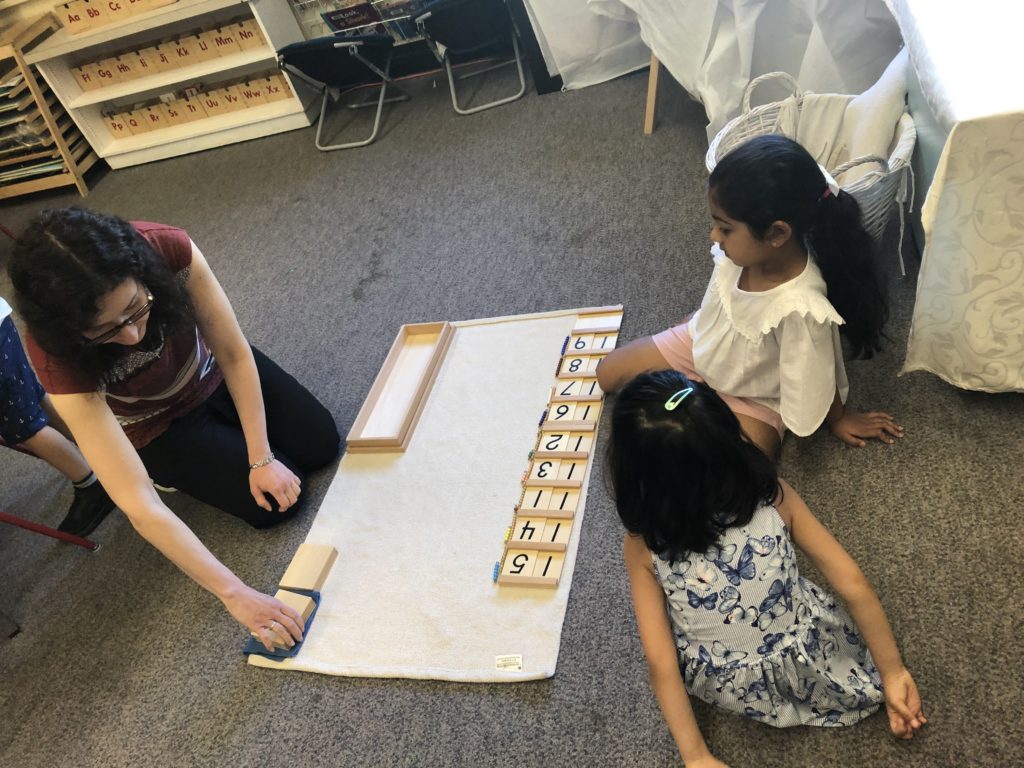
The idea of quantity is inherent in all the Montessori arithmetic materials. Dr. Montessori designed materials that help the child to concretely grasp the abstract concepts of numbers, quantity and numeric sense. The child learns how to develop an understanding of numbers through the use of tangible objects. A stable foundation in the numbers 1 to 10 leads to the exercises in the Decimal System. Operations in Addition, Multiplication, Subtraction and Division are made realistic through the use of the specially designed materials. These exercises help bring numbers come alive.
Language
The young child has a natural sensitivity for language development. Therefore, the Montessori language program begins immediately and is continuously woven into the life and work of the class. The Language materials aid the development of all three aspects of a child’s language: speaking, writing and reading. The child is exposed to tremendous vocabulary enrichment in the class. The child is encouraged to master the different skills necessary to be able to unite the operations of writing and reading. Stories and songs are widely used for language development. Grammar and creative writing are part of the older children’s work.
Sensorial Exercises
A child loves to touch. Much of the world comes to him through his hands as he investigates everything in the environment. The sensorial materials, “the keys to the universe”, present the child with a strong basis for intellectual growth and a preparation for complex learning.
The activities in this area are designed to:
- Develop visual perception
- Refine the tactile senses
- Educate the child’s sense of smelling, feeling, hearing and tasting
- Give opportunities for the child to compare, contrast, and reason, classify and categorize physical properties in the world. The sensorial exercises provide a strong preparation for the Math area.
Cultural Exercises
Science, Art, Music, Geography, Botany and History are some of the subjects covered in the cultural area. The child learns about the world – past and present. Every child enjoys learning about children from other parts of the world and what their life is like. They also love to learn about animals and their habitats. Care and observation of living plants and animals develop their relationship with other living things. We help the child realize how he is connected to his world, how he can help care for his environment and show respect for all living things.
Exercises of Practical Life
These exercises are designed to teach the child to function in his own environment, care of self and care of the environment. Exercises such as dressing frames, washing tables, preparing foods all teach personal care and care of the environment. Grace and Courtesy exercises instill good manners. The child refines her muscular coordination through movement and exploration of the surroundings. She learns to work at a task from beginning to end, developing powers of concentration.
Music
Why study music?
- Rhythm: Beginning with the walking on the line and progressing to other natural expressions of movement, such as running, skipping, and galloping, the child begins to associate certain rhythmic figures with bodily movements. Also, through the use of echoes, both verbal and rhythmic (clapping, tapping knees, snapping) children acquire a vocabulary of simple rhythms.
- Pitch: Through daily singing of songs, nursery rhymes and finger-plays, children begin to acquire a sense of pitch. The Montessori bell material affords the child the opportunity to hear musical sounds in isolation – to match, grade, and name them. Work with both the pentatonic and diatonic scale patterns gives exposure to different pitch relationships, which are the building blocks of melody.
- Timbre: Children are introduced to the instruments of the orchestra, with their various tone qualities, and learn the names of the instruments and their respective sounds.
- Intensity: Children hear pieces with different gradations of volume, a quiet lullaby, a strong march.
- Form: Children realize through listening to selected music that there is a form to music, just as there is a form (syntax) to language.
- Culture: As teachers introduce music, whether vocal or instrumental, its place and time of origin is given so children begin to relate music to history and geography.